sat suite question viewer
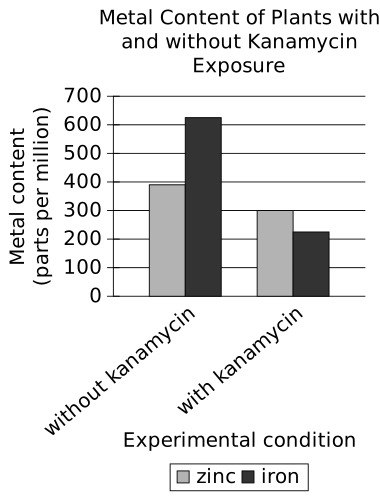
- For each data category, the following bars are shown:
- Zinc
- Iron
- The data for the 2 categories are as follows:
- Without kanamycin:
- Zinc: 390
- Iron: 625
- With kanamycin:
- Zinc: 300
- Iron: 225
- Without kanamycin:
Many plants lose their leaf color when exposed to kanamycin, an antibiotic produced by some soil microorganisms. Spelman College biologist Mentewab Ayalew and her colleagues hypothesized that plants’ response to kanamycin exposure involves altering their uptake of metals, such as iron and zinc. The researchers grew two groups of seedlings of the plant Arabidopsis thaliana, half of which were exposed to kanamycin and half of which were a control group without exposure to kanamycin, and measured the plants’ metal content five days after germination.
Which choice best describes data in the graph that support Ayalew and her colleagues’ hypothesis?
Explanation
Choice D is the best answer because it best describes data in the graph supporting Ayalew and her colleagues’ hypothesis that plants’ response to kanamycin exposure involves altering their uptake of metals. The graph compares the metal content of two groups of plants, one with kanamycin exposure and a control group without such exposure. The amount of zinc in plants without kanamycin exposure is around 400 parts per million, while the amount of zinc in plants with kanamycin exposure is lower, at around 300 parts per million. Similarly, the amount of iron in plants without kanamycin exposure is a little over 600 parts per million, while the amount of iron in plants with kanamycin exposure is lower, at a little over 200 parts per million. Thus, the graph shows that plants with kanamycin exposure have significantly lower levels of both iron and zinc than the plants without kanamycin exposure. This is evidence supporting the hypothesis that kanamycin exposure results in plants altering their uptake of metals.
Choice A is incorrect because the graph shows that control plants contained higher levels of iron than zinc, not higher levels of zinc than iron; similarly, the plants exposed to kanamycin contained higher levels of zinc than iron, not higher levels of iron than zinc. Choice B is incorrect. Though the claim that both groups of plants contained more than 200 parts per million of both iron and zinc is supported by the graph, this alone does not state whether plants with kanamycin exposure have a different metal content than plants without kanamycin exposure. Choice C is incorrect. The graph shows that the zinc levels for the control plants (those without kanamycin exposure) were around 400 parts per million, not 300 parts per million, and that the zinc levels for plants with kanamycin exposure were around 300 parts per million, not 400 parts per million.